
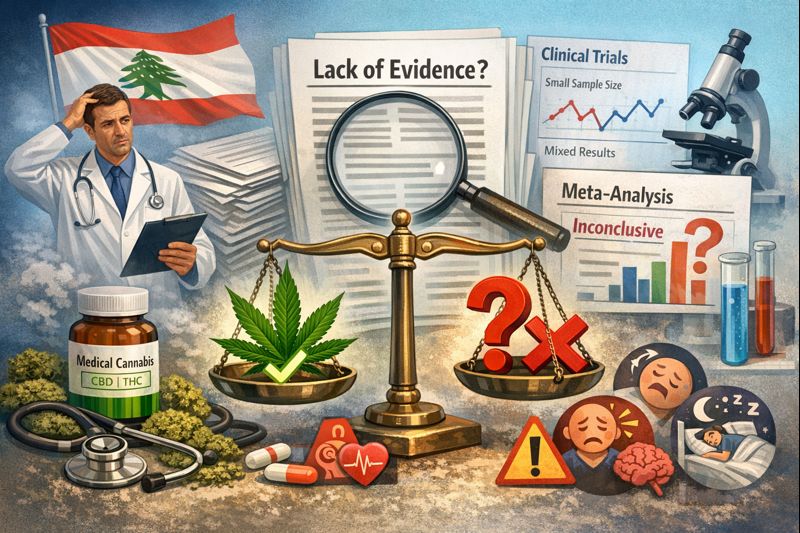
Shortage of Scientific Evidence on the Use of Medical Cannabis (Marijuana) for Various Medical Conditions
Following steps taken by the Lebanese Ministry of Agriculture to legalize “medical cannabis” (marijuana), it became necessary to pursue this issue from a scientific perspective. In this context, a major scientific review emerged, examining more than 120 selected studies out of 2,500 medical articles on the plant, addressing both its medical applications and the potential benefits and harms of its use.
A comprehensive review conducted by the University of California, Los Angeles (UCLA Health) showed that the use of medical cannabis lacks sufficient scientific evidence to treat most common conditions, including acute pain, anxiety, and insomnia.
The study, published in the Journal of the American Medical Association (JAMA), reviewed more than 2,500 articles published between January 2010 and September 2025. These included randomized clinical trials, meta-analyses, and clinical guidelines. Over 120 studies were selected based on sample size, recency, topics covered, and overall relevance.
These findings come amid the growing popularity of medical cannabis and its derivatives, such as cannabidiol (CBD). According to a 2018 survey, 27 percent of people in the United States and Canada reported using cannabis for various purposes, including pain relief, anxiety, and sleep problems.
Dr. Michael Hsu, the study’s lead author and a clinical instructor in the Department of Psychiatry and Biobehavioral Sciences at UCLA, said:
“We do not receive adequate education about medical cannabis during medical training. Many physicians lack comprehensive training on its benefits, risks, and appropriate dosing, which leads to confusion and sometimes to avoiding the topic altogether.”
The study confirmed that pharmaceutical cannabinoids approved by the U.S. Food and Drug Administration (FDA) have demonstrated effectiveness, but only for a limited range of conditions. These include appetite loss associated with HIV/AIDS, chemotherapy-induced nausea and vomiting, and certain severe seizure disorders in children, such as Dravet syndrome and Lennox–Gastaut syndrome. The study also highlighted some evidence suggesting cannabinoids may help patients with spasticity related to multiple sclerosis and certain types of chronic pain, such as neuropathic pain. For most other conditions, however, the evidence remains inconclusive or unavailable.
When asked why many people are convinced of cannabis’s benefits for medical conditions not supported by evidence, Hsu said:
“In some cases, this may be due to insufficient studies to determine its benefits, even if some exist. In other cases, cannabis may temporarily relieve symptoms but does not treat the underlying condition; it may even worsen it or interfere with engagement in other treatments such as physical or psychological therapy.”
He added:
“For some conditions, our research found evidence that cannabis is ineffective. Nevertheless, it is important to acknowledge that presenting facts or evidence alone is not sufficient without considering the human aspect of patients and their lived experiences. Being present with patients and understanding their stories is essential for providing evidence-based recommendations and addressing their underlying medical conditions.”
The review also highlighted potential health risks associated with cannabis use. Longitudinal data from adolescents indicated that high-potency cannabis may be associated with higher rates of psychotic symptoms (12.4% versus 7.1% for low-potency cannabis) and generalized anxiety disorder (19.1% versus 11.6%).
Additionally, about 29 percent of medical cannabis users meet the criteria for cannabis use disorder. Daily cannabis use—especially inhaled and/or high-potency products—may be associated with cardiovascular risks, including higher rates of coronary heart disease, heart attacks, and strokes compared with non-daily use.
The review emphasizes the need for physicians to carefully screen patients for cardiovascular disease and psychotic disorders, assess potential drug interactions, and determine whether risks outweigh benefits before considering medical use of THC-containing products.
“Patients deserve frank and objective conversations about what science does—and does not—say about medical cannabis,” Hsu said.
The researchers noted several limitations of the review. It was not a systematic review and did not formally assess the risk of bias in the included studies. Many of the reviewed studies were observational and may be subject to confounding factors. In addition, recommendations from clinical trials may not apply to all patients due to differences in study design, patient characteristics, and the cannabis products tested.
Hsu added:
“Conducting more research is critical to better understanding the potential benefits and risks of medical cannabis. By supporting more rigorous studies, we can provide clearer guidance and improve clinical care for patients.”
Researchers from Harvard University, the University of California, San Francisco, the University of Washington School of Medicine, and New York University also contributed to this study.
From an article published by UCLA Health.