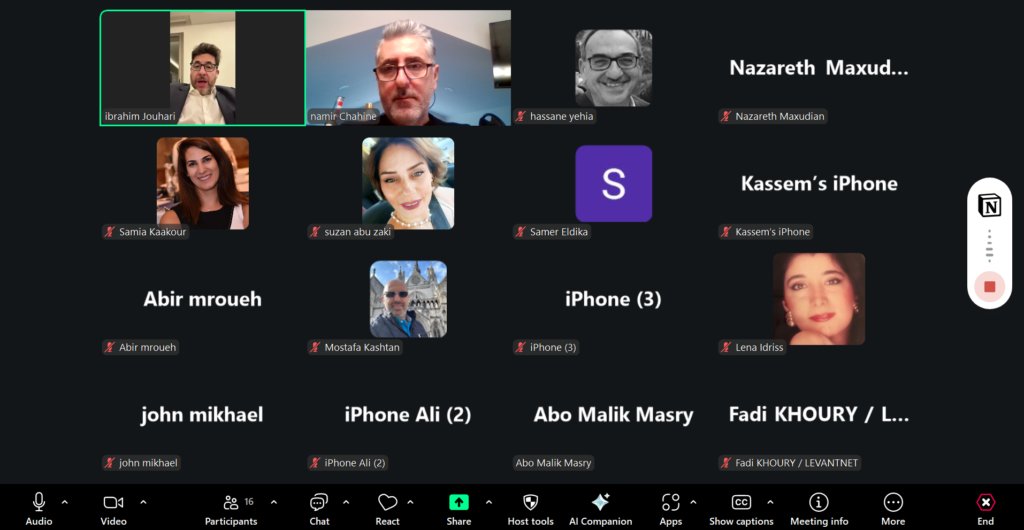
The Political Committee of the Lebanese National Alliance (LNA) held a strategic meeting to discuss a central question:
Should LNA and allied opposition forces participate in, or boycott, the 2026 parliamentary elections?
The committee hosted Mr. Ibrahim Aljawhari, consultant to the Prime Minister and elections expert, to provide insight on how to operate within an electoral law widely seen as protecting the current ruling system.
Arguments for Participation
Supporters of participation stressed that, despite all its flaws, elections remain the largest national platform available to the opposition:
• Participation affirms the legitimacy and presence of the opposition and prevents the political arena from being fully surrendered to sectarian forces.
• Campaigns help build LNA as an organization: expanding branches, activating members, creating space for youth, and deepening ties with the diaspora.
• Elections allow the Alliance to build voter databases, measure its communication strategies, and present its political vision and reform program to the public.
• Electoral campaigns develop organizational discipline, media capacity, and crisis-management skills that strengthen the movement long-term.
• Ibrahim Aljawhari noted that without the 12 current opposition MPs, national figures such as Nawaf Salam and Joseph Aoun would not have emerged as serious options in the presidential file.
Arguments for Boycott
Those favouring boycott argued that participation under current conditions risks legitimizing a corrupt system:
• The electoral law was designed by the ruling class to maintain its power, making structural change via elections extremely difficult.
• The list system forces voters into sectarian combinations, undermining the idea of civic, program-based politics.
• Elections are costly in money, time, and energy, with limited expected returns under today’s balance of power.
• Some participants stressed that Lebanon is not functioning as a normal democratic system, making routine participation tactics less effective.
• There was concern that LNA could be reduced to “just another small protest list” instead of a distinct political project.
Alternative Approaches
Between full participation and full boycott, the committee discussed several hybrid options:
• A coordinated “white paper” strategy, in which voters participate but cast blank ballots as an organized protest.
• Focusing efforts on specific regions, especially South Lebanon, where opposition forces may have room to influence outcomes.
• Ensuring that any engagement in the South reflects both internal political realities and external security threats to local communities.
• Moving beyond slogans to concrete policy proposals, including identifying key laws that should be amended or repealed.
• Investing in voter databases and organizational capacity regardless of the final decision on participation.
Political Context
The discussion took place against a backdrop of entrenched corruption, sectarianism and militia influence:
• Participants cited cases like Riyad Salameh as evidence that accountability remains blocked even with an opposition presence in parliament.
• They highlighted the heavy weight of Hezbollah and sectarian structures in shaping the political and security environment.
• Declining expatriate voter registration was noted as a sign of growing disillusionment among Lebanese abroad.
• Concerns over electoral fraud and manipulation in past cycles were also raised, alongside the impact of ongoing conflict, particularly in South Lebanon.
Next Steps
The Political Committee did not adopt a final position but agreed on several immediate action items:
• Document the full range of arguments and scenarios on participation, boycott, and hybrid strategies.
• Continue refining LNA’s political vision and reform program in preparation for any electoral scenario.
• Explore options for targeted support to candidates or alliances in South Lebanon.
• Further study the feasibility of an organized “white paper” voting campaign.
• Prioritize building voter databases and organizational infrastructure across regions.
• Develop specific policy and legal proposals, moving from general protest language to actionable reform agendas.
The meeting marked an important step in clarifying LNA’s strategic choices ahead of 2026, as the movement seeks to confront a corrupt system while preserving the possibility of peaceful, democratic change.